How to find a qualified Excelsior nursing mentor
Excelsior University does not assign you a mentor. For every MSN capstone you have to find one yourself: a master's-prepared professional with expertise in your specialization who will volunteer, and who your faculty will approve. This page explains exactly what qualifies, why the cold search is hard for working nurses, and how we source and verify a mentor so your 135 practice-experience hours can start on time.
What is a qualified Excelsior mentor?
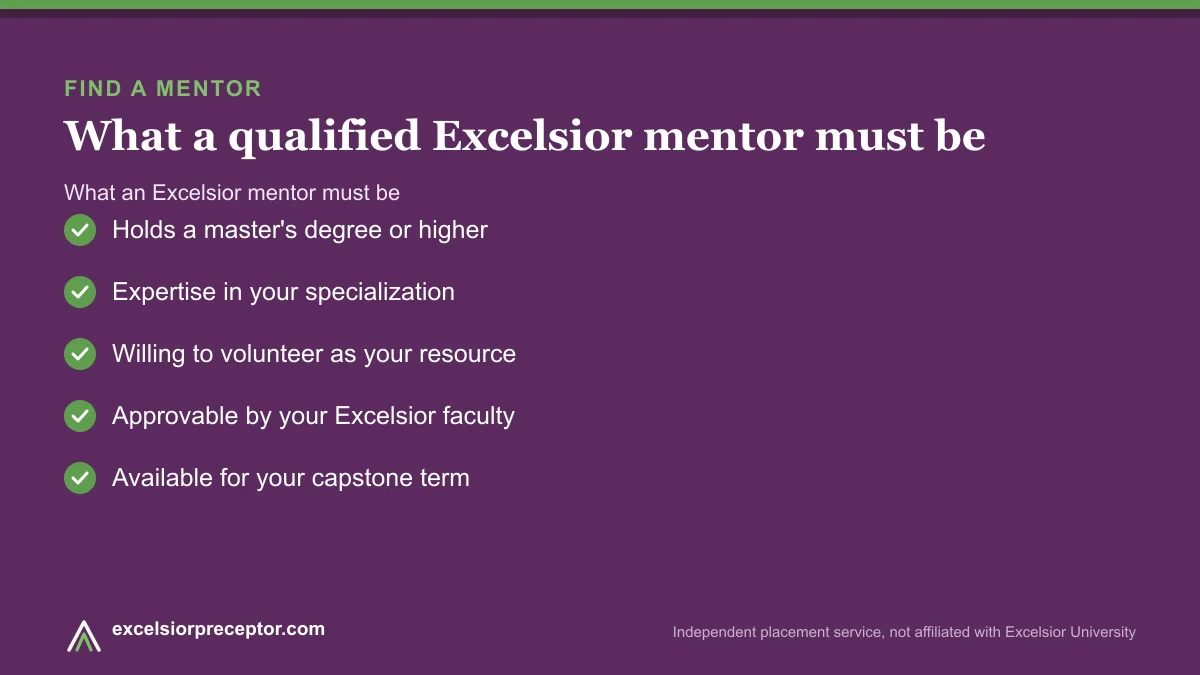
A qualified Excelsior mentor is an individual who holds a master's degree or higher, has expertise in your specialization, and agrees to volunteer as your resource for the practice experience. That is Excelsior's own standard, and it is the whole bar you have to clear. Excelsior's School of Nursing provides no clinical instruction and assigns no one to you, so faculty simply reviews and approves the mentor you bring. Excelsior's word is mentor, not preceptor, and the work is indirect-care practice experience, not a patient-care rotation. Some students still call it a preceptor out of habit; the requirement is the same person either way.
Does the mentor have to be a nurse?
Not necessarily. The fixed requirements are the graduate degree, the specialization expertise, and the willingness to volunteer, so the best-fit mentor depends on your track and your project. A Nursing Education project usually points to a master's-prepared nurse educator or staff-development leader. A Nursing Informatics project may fit a clinical informatics director or an analyst who holds a graduate degree. A Nursing Leadership and Administration project often fits a nurse manager, director, or administrator. What matters is that the person can credibly guide your independent project and that your faculty approves their fit. We match on that fit rather than on a title alone.
Why is finding a mentor cold so hard for working nurses?
Because Excelsior gives you an open-ended assignment on top of a full-time job. You are asked to identify a graduate-prepared professional, confirm they will donate their time, collect enough detail for faculty to approve them, and finish all of that months before your capstone term opens. Most students start by emailing managers and former instructors, hear nothing back for weeks, and lose the runway they needed. The people who make good mentors are busy, and a stranger's cold request is easy to leave unanswered. That is the gap that quietly pushes capstones a full term late. If you are weighing the search yourself, see our honest look at DIY versus using a placement service.
The real cost of a slow search: a capstone you cannot staff does not slip by a week, it slips by a term, and a term of the MSN moves your whole graduation. Starting the mentor search early is the cheapest insurance you have.
How do we source and verify your mentor?
We run the search you would otherwise run alone, only with a network and a process behind it. Here is what that looks like in practice.
- We scope your project first. Your track, your setting, and your capstone term tell us what kind of mentor faculty will approve, so we look for the right person, not just any willing one.
- We source master's-prepared candidates. We reach professionals whose graduate degree and specialization fit your project and who are open to volunteering as a mentor.
- We verify the credential and the fit. We confirm the master's degree or higher and the specialization expertise before we bring anyone to you, so you are not chasing a dead end.
- We prepare for faculty approval. We organize the mentor detail your Excelsior faculty needs to review, since faculty approves the mentor rather than assigning one.
- You approve, then you start. Nothing is final until you say yes and faculty signs off. We line the mentor up next to the site and the project so all three arrive together.
Do you pay the mentor?
No. The Excelsior mentor volunteers, and we never pay the mentor. Our flat placement fee covers our own work: sourcing candidates, verifying credentials, coordinating the practice-experience site and any affiliation agreement, and shepherding your CastleBranch compliance. Paying a mentor to accept would be inappropriate, and it is not something we do or offer. You pay us only once your mentor and site are confirmed.
How far ahead should you start?
Start four to six months before your capstone term. Confirming a mentor, securing the site, clearing any affiliation agreement, and finishing CastleBranch background, drug screen, and immunization checks all take time, and faculty approval is a step you cannot compress. Early is the whole game. If your capstone term is close and you have no mentor yet, that is exactly when to hand the search to us so it does not cost you a term.
Common questions about the mentor
What makes someone a qualified Excelsior mentor?
Excelsior defines a qualified mentor as an individual with a master's degree or higher and expertise in your specialization who volunteers to serve as your resource for the practice experience. Faculty reviews and approves the mentor; Excelsior does not assign one. The mentor guides your independent project across your 135 practice-experience hours.
Does the mentor have to be a nurse?
Not always. The requirement is a master's degree or higher and expertise that fits your specialization and project. For a Nursing Informatics or Leadership project the best-fit mentor may be an informatics director or an administrator rather than a bedside nurse. Faculty approves the specific person and their fit to your project.
Why is finding an Excelsior mentor hard for working nurses?
Excelsior provides no clinical instruction and hands you an open-ended search while you work full time. You have to identify a master's-prepared professional, confirm they will volunteer, gather documentation for faculty approval, and do it months before your capstone term. Most students underestimate how long that takes.
Do you pay the mentor to say yes?
No. The Excelsior mentor is a volunteer, and we never pay the mentor. Our flat placement fee covers our own work sourcing and verifying the mentor and coordinating the site and paperwork. Paying a mentor would be inappropriate and is not part of what we do.
How far ahead should I start looking for a mentor?
Start four to six months before your capstone term. Mentor confirmation, the practice-experience site, any affiliation agreement, and CastleBranch clearance all take time, and faculty approval is a step you cannot rush. Early searching is the single biggest thing that keeps a capstone on schedule.
Let us find your mentor
Tell us your Excelsior program, your city, and your capstone term. We will come back with a plan and a master's-prepared, specialty-matched mentor you can approve.
Related
Is a capstone mentor required?
Yes, for every Excelsior MSN capstone, and you are the one who finds yours. Here is how approval works.
How to ask someone to be your mentor
A practical script for the ask, plus two copy-paste email templates that respect a busy professional's time.
Mentor vs preceptor
Why Excelsior's word is mentor, and what the indirect-care practice experience changes about who qualifies.