Lining up a mentor, a site, and a project in South Carolina
Excelsior does not assign you a mentor and does not find you a host agency. If you are finishing an MS in nursing education, informatics, or leadership from somewhere between Greenville and the Lowcountry, the capstone is yours to assemble. Here is how that goes in South Carolina.
The license South Carolina cares about is the one you already hold
Your regulator is the South Carolina Board of Nursing, housed inside the state Department of Labor, Licensing and Regulation in Columbia. It licenses RNs, publishes a free public license lookup, and runs renewals on a two year cycle with an April 30 deadline in even numbered years. Confirm the current cycle and continuing competence rules on the board's own pages, not on a nursing forum.
Before a hospital education department, a county health office, or a college of nursing gives you a term inside their operation, someone in HR or academic partnerships will run your name through that lookup. A lapsed license, or a name that does not match your school record, stalls a placement faster than anything else here.
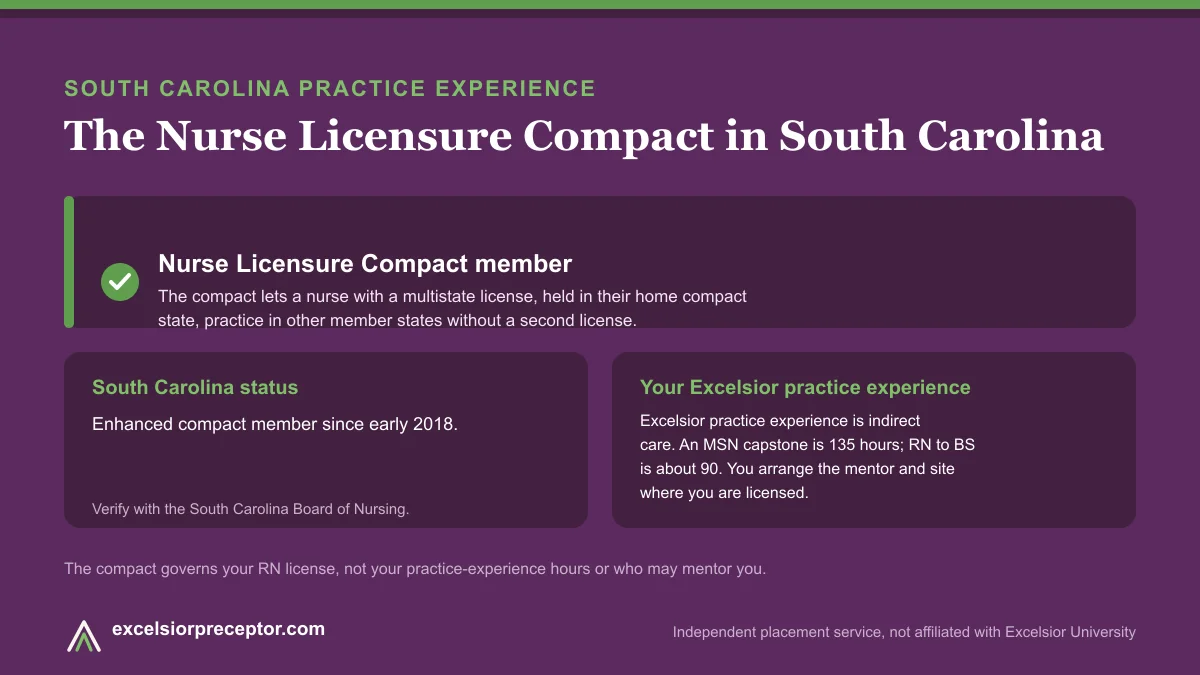
South Carolina is a Nurse Licensure Compact state, so if it is your primary state of residence and you hold a multistate license, you have room to work with when the best mentor for your specialization sits over the line in Charlotte, Augusta, or Savannah. Either way, the practice experience does not change your license or your scope. You are not practicing under your mentor. You are a licensed RN doing indirect care project work, and the license is simply what gets you through the door.
Who counts as a mentor here, and where those nurses sit
Excelsior's requirement is narrower than students expect. Your mentor must be master's prepared with genuine expertise in your specialization. You nominate the person, faculty approves or declines, and faculty does not go looking on your behalf. Some students call it a preceptor, which is what everyone types into a search bar, but Excelsior's word is mentor and the difference is more than vocabulary. See mentor vs preceptor.
For nursing education, look for nursing professional development specialists, clinical education managers, and faculty. They work in the education departments at Prisma Health in Greenville and Columbia, MUSC Health in Charleston, Spartanburg Regional, Lexington Medical Center, McLeod Health in Florence, Roper St. Francis, AnMed in Anderson, and Self Regional in Greenwood. They also teach at the University of South Carolina, MUSC, Clemson, Winthrop, Francis Marion, Coastal Carolina, Lander, USC Upstate, and the technical colleges in Columbia, Greenville, Charleston, and Conway.
For nursing informatics, the state has a deeper bench than its size suggests. Large systems staff clinical informatics and electronic record analyst teams, and Columbia is a health data town: BlueCross BlueShield of South Carolina and its Medicare contractor subsidiary Palmetto GBA employ a sizable technology workforce. Nurses with informatics duties also sit in quality departments and telehealth programs.
For nursing leadership, nurse managers, directors, quality and patient safety leaders, infection prevention leads, and public health administrators qualify when their credentials and scope match your project. Look past the big systems. The South Carolina Department of Public Health and county health offices, federally qualified health centers, school district nursing programs, hospice and home health agencies, and long term care organizations often welcome a leadership project a busy hospital unit has no time to supervise.
Getting a site to say yes, then getting the paperwork signed
The mentor and the site are two separate approvals, and students routinely land the first and stall on the second. A willing director cannot sign for the organization. Above them is the person who handles student affiliation agreements, usually in human resources, legal, or academic partnerships. Ask your mentor who that is on the first call, not in week four.
Timelines vary. Coastal and Upstate systems that already host hundreds of nursing students have a template and a queue you wait in. A small county agency or nonprofit clinic may never have seen a student agreement and will send it to an attorney who reviews contracts once a month. Budget weeks, not days. Then comes compliance: Excelsior works through CastleBranch, and the host usually adds its own onboarding, including immunization records, a background check, a drug screen, and current CPR. Start that file the day your site says yes, because a missing titer has cost more than one student a full term.
Four questions for the first call with a site
- Who signs student affiliation agreements here, and how long does that take?
- Do you require onboarding on top of my school's CastleBranch requirements?
- Will my mentor be here all term, or is a move or retirement coming?
- Is there a project the department already needs done that I could take on?
What the hours really look like
The graduate capstone is 135 practice experience hours built around one independent project, a figure Excelsior states openly on its program pages. RN to BS students carry a lighter load, roughly 90 hours across two 45 hour courses. Both are broken down on practice experience hours and RN to BS practice experience.
Across a fifteen week term, 135 hours is about nine hours a week, which most working nurses fold into two evenings and part of a weekend. The students who struggle rarely ran short of time. They spent the first six weeks hunting for a signature. The hours themselves are mentor meetings, data and literature gathering, building the deliverable, presenting it, and evaluating what happened. A capstone practice experience is not a clinical rotation and is not direct patient care, and that distinction matters when a site tries to slot you into a prelicensure student orientation. Project ideas by specialization are on capstone project.
Remote work, hybrid arrangements, and the geography problem
South Carolina is not evenly served. Charleston, Columbia, Greenville, Spartanburg, Rock Hill, Florence, and the Myrtle Beach corridor have plenty of master's prepared nurses. Stretches of the Pee Dee, the southern counties along the Savannah River, and the rural midlands do not, and a student there can be an hour from the nearest nurse with the right credentials and specialty.
Indirect care work travels well, though. Curriculum revision, a policy rewrite, an onboarding redesign, a dashboard build, a quality improvement plan: much of it happens on a laptop and a video call, and rural sites are sometimes the most willing hosts because they need the work done. What you cannot do is decide this alone. The site has to agree and faculty has to approve the plan before you count hours, so get it in writing from both. If the right mentor sits across a state line, read out of state practice experience first.
If you would rather not spend six weeks cold calling
We are an independent placement service, separate from Excelsior University. We do the part students dislike: finding master's prepared mentors in South Carolina whose expertise matches your specialization, approaching agencies that can actually sign an affiliation agreement, and keeping the compliance file moving. We assist, we do not guarantee placement, and we cannot promise faculty approval of any mentor or site. If your term starts soon, see need a mentor fast. Pricing is on cost, the process is on how it works, and you can get matched with your specialization, county, and term start date.
Answered
Does my mentor have to hold a South Carolina nursing license?
A mentor working in South Carolina will hold either a South Carolina license or a multistate compact license covering work here, since they practice under their own credentials. What Excelsior asks about is preparation and fit: master's prepared, expertise in your specialization, approved by your faculty. If your prospective mentor is a non nursing expert in an informatics or administrative setting, ask your program first.
Can I do my practice experience where I already work?
Many South Carolina students do, and it removes real friction around badges and system access. Two cautions. Your employer may still need a signed affiliation agreement with the school even though you are staff, and your program may have a view on whether your direct supervisor can serve as mentor. Ask both in writing before building a project on the assumption.
I am in Excelsior's prelicensure or associate degree program. Can you help?
No, and we would rather say so plainly. Those programs are structured differently and Excelsior arranges their clinical placements, including the hybrid prelicensure program based in St. Petersburg, Florida. Our work is the graduate capstone and the RN to BS practice experience courses, where the school does not assign a mentor or a site.
My site is in Georgia or North Carolina. Is that a problem?
Not automatically, and it is common near Augusta, Charlotte, and Savannah. Two things change. The affiliation agreement is with that out of state agency, so its legal review and compliance rules apply, and if your license is single state rather than multistate, check the compact rules where the agency sits.
Let us line up the mentor, the site, and the project.
Tell us your program and your term. No payment until you are matched.
Get matched with a mentor