Lining up a mentor and a practice-experience site in New York
Excelsior University sits on Columbia Circle in Albany, so New York students often assume the school has local doors it will open. It does not. Excelsior states that no clinical instruction is provided in any School of Nursing program, which leaves the mentor, the site, and the project to you.
What a New York student has to line up
Every Excelsior graduate specialization ends in a capstone worth 135 practice-experience hours. Before it opens you need a volunteer mentor your faculty has approved, a host site willing to have you, and a project worth 135 hours of somebody's attention.
None of it is direct patient care. Excelsior's graduate degrees are indirect care by design: MS in Nursing Education, MS in Nursing Informatics, MS in Nursing Leadership and Administration, plus the RN-to-MS bridges. A practice experience is a supervised project inside a real organization, not a clinical rotation. Students often say preceptor because that is the word nursing school taught them, but Excelsior's word is mentor, and the difference matters when you ask a New York health system for access.
The four pieces
- A mentor. Master's prepared, expertise matching your specialization, volunteering the time. You nominate; faculty approves. Faculty does not assign anyone.
- A site. A hospital, school of nursing, county health department, insurer, or health-IT organization that will host the work and sign an affiliation agreement.
- A project. Independent, measurable, scoped to fill 135 hours in education, informatics, or leadership.
- Compliance. Your CastleBranch file cleared before the site lets you in.
In New York, an education agency licenses you
Most states put nursing licensure under a health agency. New York does not. Registered nurses here are licensed by the New York State Education Department through its Office of the Professions, and the New York State Board for Nursing, on Washington Avenue in Albany, advises the Board of Regents on nursing practice.
New York also separates the license from the registration. The license does not lapse; the registration expires, and you renew it every three years to keep practicing as an RN. A host site checking your credentials is looking at registration status and registered-through date, both visible in NYSED's public verification search. Pull your own record early and read it the way a placement coordinator will.
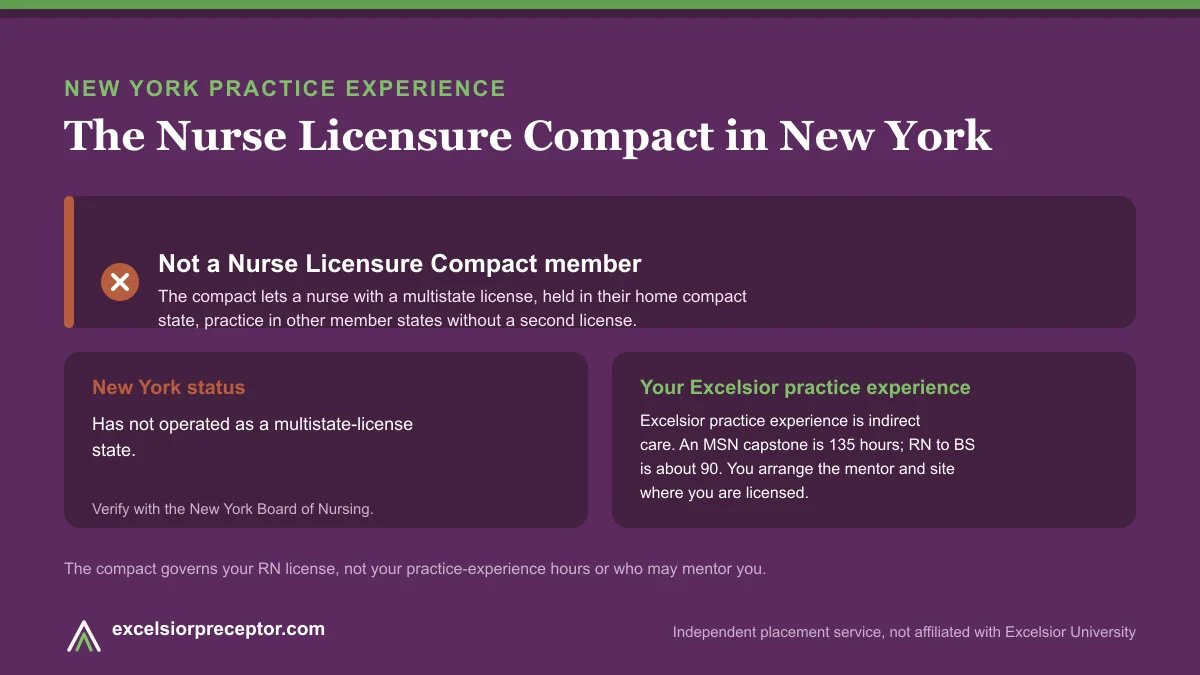
On the Nurse Licensure Compact, do not guess. New York has not operated as a multistate-license state, and compact status changes without most nurses hearing about it, so confirm at nursecompact.com before assuming a license issued elsewhere covers work here.
Who can mentor you here, and where they work
The requirement is narrower than students expect and wider than they fear: someone master's prepared whose expertise matches your specialization. No academic or management title required, and no bedside role. An education student needs someone who teaches or builds curriculum. An informatics student needs someone who lives in clinical systems and data. A leadership student needs someone running a unit, a service line, or a quality program.
New York is deep in all three, and not only in Manhattan. A mentor in Watertown, Elmira, or Jamestown counts as much as one at a Midtown academic center, and smaller organizations often say yes faster.
Where New York mentors turn up
- Education. Schools of nursing at the University at Buffalo, Binghamton's Decker College, SUNY Upstate, Stony Brook, the University of Rochester, Hunter-Bellevue at CUNY, and Maria College in Albany, plus SUNY and CUNY community college programs and hospital nursing professional development departments.
- Informatics. Clinical informatics teams at Northwell Health, NewYork-Presbyterian, Mount Sinai, Montefiore, NYC Health + Hospitals, and Albany Med, plus the regional health information organizations: HEALTHeLINK in Buffalo, Rochester RHIO, HealtheConnections in Syracuse, Hixny in the Capital Region, and Healthix in New York City.
- Leadership. Nurse managers, directors, and quality leaders at Westchester Medical Center, Erie County Medical Center, St. Peter's Health Partners, and United Health Services in Binghamton.
- Public health. The New York State Department of Health, the New York City Department of Health and Mental Hygiene, and county health departments in Erie, Monroe, Onondaga, and Westchester counties.
The BSN in 10 law, and the RN-to-BS hours
New York is the reason many RNs are in a bachelor's program at all. Under the state's BSN in 10 law, registered nurses licensed here who do not meet certain exemption conditions must earn a baccalaureate or higher degree in nursing within ten years of becoming licensed in New York, and an amendment to the Regulations of the Commissioner of Education took effect on April 29, 2026 that further defines those requirements. Check NYSED's license-requirements page for whether an exemption applies to you.
If that law is what put you in Excelsior's RN-to-BS program, the practice-experience piece is smaller: about 90 hours across two 45-hour courses, not 135 in a single capstone. It is still yours to arrange, but the ask you are making of a busy New York nurse is roughly half the size. See RN-to-BS practice experience and practice-experience hours.
Getting a New York site to sign, and the remote question
The affiliation agreement is where New York placements stall. Large systems here run formal student-placement offices with queues, standard contract language, and insurance thresholds, and a one-off request from a single master's student is easy to leave in an inbox. Ask the right office: not the nurse manager and not HR, but student placement, academic affairs, or nursing professional development. Arrive with the paperwork assembled instead of asking what they need.
Compliance runs through CastleBranch, and New York sites often add a layer of their own: occupational health forms, an orientation module, sometimes a separate background check. Budget weeks, not days. Our how it works page walks the sequence.
Some of this work can be done remotely. Curriculum revision, a data-quality audit, a policy rewrite, a dashboard build: none of it requires standing in a building. What we will not tell you is that it counts. Whether remote hours satisfy your course depends on your site's agreement and your faculty's judgment, so ask your program in writing before you build a plan around it.
If you would rather not spend a term cold-emailing directors who never write back, get matched and we will source the mentor, approach the site, and hand you a nominee your faculty can review. If a mentor already backed out, start at need a mentor fast.
Answered
Excelsior is based in Albany. Will the school find me a placement in New York?
No. Excelsior was founded by the New York State Board of Regents in 1971 and is headquartered on Columbia Circle in Albany, but that is an administrative address, not a placement network. The School of Nursing provides no clinical instruction, and students arrange their own mentor, site, and project wherever they live. Faculty approves your nominee, it does not assign one.
Does my mentor have to work in direct patient care?
No, and usually they do not. Excelsior's graduate nursing degrees are indirect care, so the requirement is a master's prepared nurse whose expertise matches your specialization. A curriculum designer at a SUNY nursing program, a clinical informatics lead at a Buffalo health system, or a quality director at a county health department can all qualify. See mentor vs preceptor.
How many practice-experience hours will I owe?
135 for each MSN capstone, whether your specialization is education, informatics, or leadership and administration. RN-to-BS runs about 90 hours across two 45-hour courses, logged with your mentor and reported to faculty.
Can my practice experience be outside New York?
Often, yes. What governs is your licensure, the receiving site's affiliation agreement, and faculty approval, not a state line. If the strongest mentor sits across a border in New Jersey, Connecticut, Vermont, or Pennsylvania, that is worth pursuing. Read out-of-state practice experience and settle licensure before you commit.
How far ahead should a New York student start?
A full term before the capstone opens, at minimum. The affiliation agreement is the long pole: a large system's student-placement office can take a month or more to move a new agreement through legal review, and CastleBranch clearance runs alongside it. Students who start in the same term the capstone begins are the ones who defer, and delayed graduation is what that costs.
Let us line up the mentor, the site, and the project.
Tell us your program and your term. No payment until you are matched.
Get matched with a mentor