Finding a mentor, a site, and your 135 hours in Maryland
Excelsior will not assign you a mentor and will not place you at an agency. In Maryland that work is yours, and it is doable once you know who to ask and in what order.
What you are actually assembling
An Excelsior graduate capstone in Maryland comes down to three pieces that have to land together. A mentor who holds a master's degree or higher and works in your specialization, whether that is education, informatics, or leadership. An agency willing to host you and sign an affiliation agreement. A project with a real question behind it. Faculty approve the mentor you nominate; they do not go find one for you.
A practice experience is not a clinical rotation, and at the graduate level it is not direct patient care. You are writing curriculum, tightening a documentation workflow, or running a quality project. Some students say preceptor, because that is the word the rest of nursing uses, but Excelsior's word is mentor and the paperwork uses it. See mentor vs. preceptor and what a practice experience is and is not.
The Maryland Board of Nursing and your RN license
Registered nurses here are licensed by the Maryland Board of Nursing at 4140 Patterson Avenue in Baltimore. Applications, renewals, and license management now run through a system called MDH CHART, and the public license lookup lives there too. Renewal follows your birth month: licenses expire on the 28th day of it, and online renewal opens 90 days before that date and stays open for 30 days after.
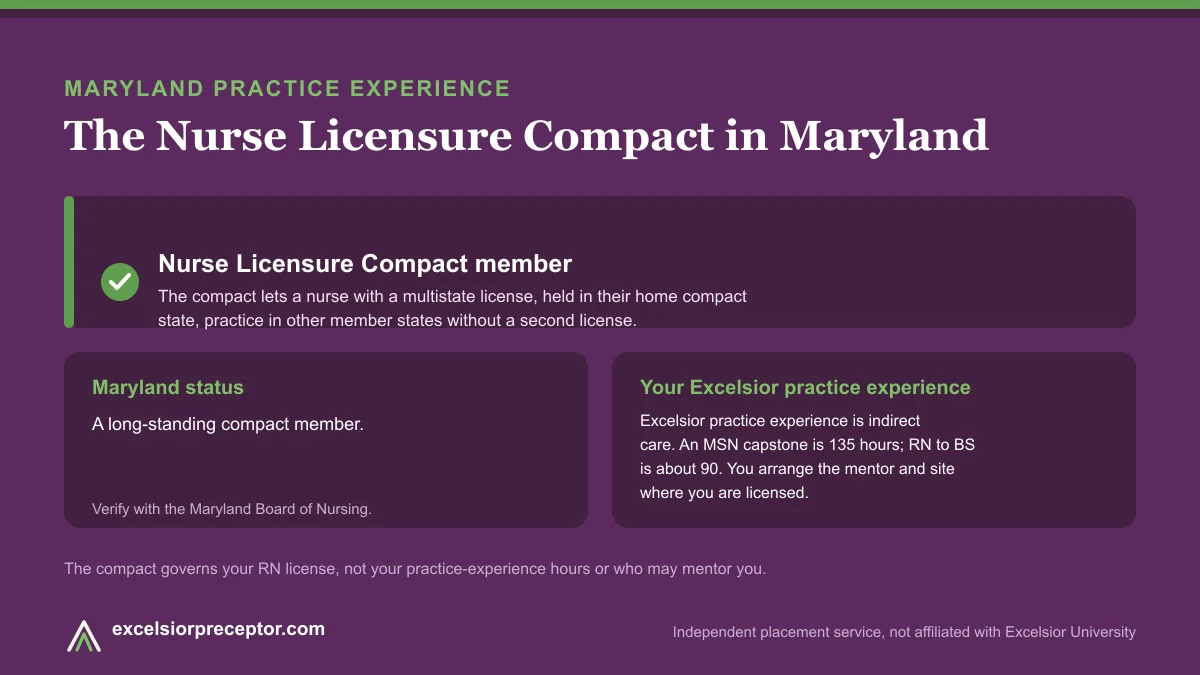
Maryland is a compact state, and an early one. The board notes that Maryland was the first state to join the Nurse Licensure Compact in 1999, and it moved to the current version effective January 19, 2018. There are 43 participating jurisdictions. If Maryland is your primary state of residence and you hold a multistate license, it travels with you, which matters when a mentor or a site sits just over a state line. Check the receiving state on nursecompact.com first, and treat Washington, DC as its own question.
Licensure matters here for a practical reason. The agency hosting you will run a primary source verification before it badges you or opens a record system to you, and risk management owns that step, not the nursing department. It is a common place for a start date to slip, so pull your verification early.
Where Maryland mentors actually work
Your mentor has to be master's prepared with expertise that matches your specialization. Maryland has a deep bench in all three tracks, partly because so much of the country's health policy and health research infrastructure sits inside the state.
Places to look, by track
- Education: nursing faculty and clinical education offices at the University of Maryland School of Nursing in Baltimore and at the Universities at Shady Grove in Rockville, Johns Hopkins School of Nursing, Towson, Salisbury, Coppin State, Bowie State, Notre Dame of Maryland, Stevenson, and Frostburg State, plus community college programs at CCBC, Montgomery College, and Wor-Wic in Salisbury. Hospital staff education departments count too.
- Informatics: informatics teams at Johns Hopkins Medicine, the University of Maryland Medical System, MedStar Health, LifeBridge Health, Luminis Health, Adventist HealthCare, Frederick Health, Meritus Health in Hagerstown, and TidalHealth in Salisbury. Maryland also hosts CRISP, the state designated health information exchange, in Columbia, plus the Centers for Medicare and Medicaid Services in Woodlawn, the Food and Drug Administration in Silver Spring, and the National Institutes of Health in Bethesda.
- Leadership: nurse managers, directors, and quality leaders across those same systems, plus the Baltimore City Health Department, Montgomery County Health and Human Services, the Prince George's County Health Department, and the county health departments on the Eastern Shore and in Western Maryland. Maryland is also the one state that sets hospital rates through a public commission, so cost and utilization projects land well locally.
The site, the agreement, and CastleBranch
A mentor without a site is half the job. The agency has to agree to host you, and an affiliation agreement usually has to be in place before your first hour counts. Large Maryland systems route these through legal or an academic partnership office, on institutional time rather than student time. Six to eight weeks is normal at a big system. County health departments and smaller agencies often move faster.
Excelsior uses CastleBranch, so expect a background check, immunization records, TB screening, and whatever the host adds. Federal and military sites are everywhere here, from the National Institutes of Health to Walter Reed National Military Medical Center to the VA Maryland Health Care System, and they add their own clearance steps. Start those early. See affiliation agreements and CastleBranch compliance.
The hours, stated plainly
Each MSN capstone carries 135 practice experience hours completed with an approved mentor, and Excelsior is explicit that no additional hours are awarded beyond the 135. That holds for Nursing Education, Nursing Informatics, and Nursing Leadership and Administration, including the RN to MS bridges.
On the RN to BS track the practice experience is smaller, roughly 90 hours across two 45 hour courses. Same logic, lighter load, and the same requirement that you bring the mentor and the site. Practice experience hours and the capstone project go deeper.
Remote and hybrid hours in a state built for it
Indirect care work often does not require a chair in a building. Curriculum review, informatics analysis, dashboard work, quality and policy projects: much of it can run partly remote when the site and faculty agree. Maryland makes that easier than most states, because so many of these roles around Baltimore and the Washington suburbs are already hybrid.
Get it in writing from your mentor and your faculty before you plan around it. We will not tell you remote hours count, because that call belongs to your program. If your mentor or site sits outside Maryland, read out of state practice experience first.
If you would rather not run this search yourself, that is what we do. We source the mentor and the site, make the introductions, and stay on it until the agreement is signed. Get matched, or read how it works and our pricing first.
Answered
Does Excelsior find my mentor in Maryland?
No. In the graduate and RN to BS nursing programs the university does not provide clinical instruction and does not assign mentors or sites. You nominate a mentor and secure a site, and faculty review and approve what you bring. That gap is why a service like ours exists.
Can I do the capstone where I already work?
Often yes, and it is the quickest route. The usual conditions are that the project is genuinely a project and not a restatement of your job duties, and that your employer will sign the agreement. Programs vary on whether a direct supervisor can also be your mentor, so ask your faculty.
I hold a multistate license from another compact state. Can I do my practice experience in Maryland?
Maryland participates in the Nurse Licensure Compact, so a multistate license from your primary state of residence generally carries privileges here. Confirm with the Maryland Board of Nursing and on nursecompact.com, and expect the host agency to verify your license regardless.
How early should I start?
Three to four months before your capstone term. The mentor conversation is rarely the slow part. The affiliation agreement and the compliance file are, especially at a large Baltimore or Washington suburb system and at any federal site.
Is this the same as the clinical hours I did for my RN?
No. Graduate practice experience at Excelsior is indirect care: education, informatics, or leadership work built around a project you design with your mentor. It is not direct patient care and it is not supervised bedside practice.
Let us line up the mentor, the site, and the project.
Tell us your program and your term. No payment until you are matched.
Get matched with a mentor