Lining up your mentor, site, and project in Kentucky
Excelsior University does not assign mentors or practice-experience sites, so a graduate nursing student in Kentucky arranges all three pieces: the mentor, the host agency, and the project. Here is how that works in the Commonwealth.
The three pieces you have to bring
Excelsior's graduate nursing programs are indirect care. The MS in Nursing Education, Nursing Informatics, and Nursing Leadership and Administration each end in a capstone built around a practice experience, and the RN-to-BS track has a smaller version. Excelsior states that no clinical instruction is provided in any School of Nursing program, so the mentor, the site, and the project are yours to line up.
Excelsior's word is mentor, not preceptor, though plenty of students say preceptor because that is what they typed into a search bar. A practice experience is not a clinical rotation and it is not direct patient care. You run an independent project with a master's prepared nurse guiding you, and faculty approves the person you nominate rather than handing you a name. See mentor vs preceptor and how a practice experience differs.
What a Kentucky student has to secure
- A master's prepared mentor matching your specialization, approved by your faculty
- A Kentucky agency, department, or school willing to host the work
- An affiliation agreement signed before hours count
- A project the site actually wants done
- CastleBranch compliance cleared before your start date
Your RN license is the first thing a site checks
You are already a licensed RN, so the regulator that matters here is the Kentucky Board of Nursing. KBN runs a license verification portal that updates in real time, and employers also pull records through Nursys QuickConfirm. Expect the department hosting you to run one of those checks before anyone prints you a badge.
Kentucky runs licensure on a November 1 to October 31 cycle, with renewal open in the KBN Nurse Portal from September 15 to October 31 and continuing education or competency requirements across that period. If your capstone straddles the fall, renew early. No host will keep you on site with a lapsed credential.
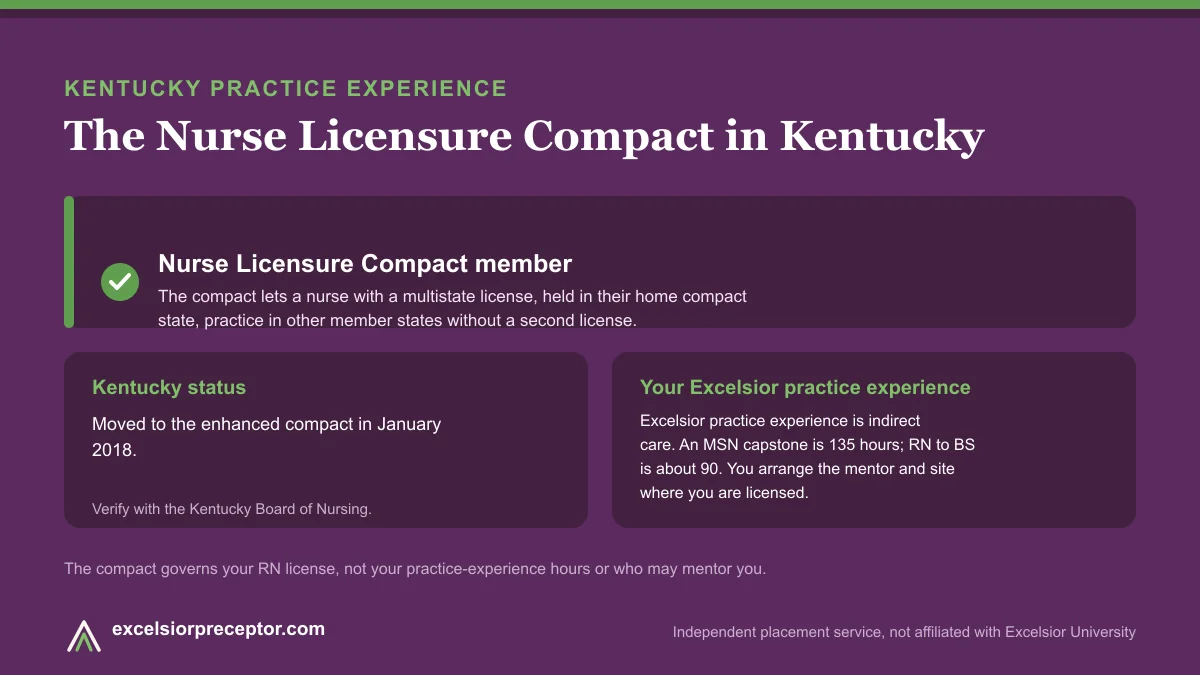
Kentucky is a Nurse Licensure Compact member. A multistate license comes from your primary state of residence, and you can hold one in only one compact state at a time, so a move changes what you carry. Confirm your status with KBN before setting a start date. If the practice experience will sit outside Kentucky, read out-of-state practice experience first.
Where master's prepared mentors actually work here
Your mentor needs a master's degree and real expertise in your specialization. That filter is narrower than it sounds, and it is where students get stuck. Kentucky helps a little, because it concentrates qualified people into a few recognizable corridors.
Louisville and Lexington carry most of the volume. Norton Healthcare, UofL Health, and Baptist Health run sizable operations around Louisville, and UK HealthCare anchors Lexington at the University of Kentucky Albert B. Chandler Hospital. Northern Kentucky has St. Elizabeth Healthcare across Edgewood and Covington. Beyond those hubs, Owensboro, Bowling Green, Paducah, Ashland, Frankfort, Hazard, and Pikeville support hospitals and agencies with professional development, quality, and informatics staff.
Where to look, by specialization
- Nursing education: hospital professional development departments, plus nursing faculty at the University of Kentucky, the University of Louisville, Western Kentucky, Eastern Kentucky, Northern Kentucky, Murray State, Morehead State, Bellarmine, and the Kentucky Community and Technical College System. See education mentors.
- Nursing informatics: hospital clinical informatics and electronic health record teams. The Kentucky Health Information Exchange, administered by the Cabinet for Health and Family Services, links hospitals and ambulatory sites statewide. See informatics mentors.
- Leadership and administration: nurse managers, directors of nursing, quality and patient safety leaders, accreditation coordinators. See leadership mentors.
- Public health: the Kentucky Department for Public Health, which houses a public health nursing office, plus local and district health departments. These often employ master's prepared nurses and are more approachable than a large system.
The site, the affiliation agreement, and CastleBranch
A willing mentor is not a willing site. The organization has to agree to host you, and Excelsior needs an affiliation agreement with it before hours count. That step quietly eats weeks here, because the signature usually travels up to a system office rather than staying with the department that told you yes.
Start the paperwork the day your mentor agrees verbally. Ask who signs affiliation agreements for their organization, then pass that name to your program so the two offices talk directly. Smaller settings move faster: a district health department, a community college program, or a single-site clinic can turn one around while a large system is still deciding which office owns it. See affiliation agreements.
Compliance runs through CastleBranch: immunizations, background check, drug screen, and whatever the host adds. Start early, because an expired titer can hold your start date longer than the agreement will. CastleBranch compliance has the usual list.
Counting the hours honestly
Each MSN capstone carries 135 practice-experience hours. That is the number to plan around, and it does not survive being stretched across a year, because the project loses momentum and the site loses interest. Ten to fifteen hours a week puts a capstone at roughly nine to twelve weeks.
RN-to-BS students carry about 90 hours split across two 45-hour courses. Same structure, smaller footprint, and usually easier to place because the ask on the host is lighter. See RN-to-BS practice experience.
Either way, the hours attach to a project the organization actually wants: a curriculum revision, an onboarding redesign, a workflow audit, a quality dashboard, a policy rewrite. Arriving with a project someone already wanted is the most reliable way to turn a maybe into a yes. Capstone project has examples; practice-experience hours covers documentation.
Remote and hybrid work, and what to confirm
Much indirect-care work does not require standing in a building. Curriculum design, informatics analysis, policy drafting, and quality review are laptop work, and some Kentucky sites will run part of a practice experience that way. That matters if you live two hours from the department you need.
Do not assume it. Remote or hybrid arrangements need agreement from both the site and your Excelsior faculty, and terms shift by course. Ask both before you build a schedule on it. The ones that get approved are usually those where the mentor could describe concrete supervision and deliverables.
If your mentor backs out or the calendar is tight, that is common and fixable. See mentor backed out and need a mentor fast.
If you would rather not run this search yourself, that is our job. We source the mentor, push the affiliation agreement through, and hand you a Kentucky site that has already agreed. Get matched, or read what it costs first.
Answered
Does Excelsior find my mentor for me?
No. Excelsior states that no clinical instruction is provided in any School of Nursing program, and faculty approve the mentor you nominate rather than assigning one. You find a master's prepared nurse whose expertise matches your specialization, then submit the nomination.
Does my compact license cover me in Kentucky?
Kentucky is a Nurse Licensure Compact member, so a multistate license from your primary state of residence generally covers practice here. You can hold one in only one compact state at a time, and changing residency starts a clock on applying in the new one. Confirm your status with the Kentucky Board of Nursing before setting a start date.
How many hours will I need?
Each MSN capstone is 135 practice-experience hours. RN-to-BS students carry about 90 across two 45-hour courses. Those totals attach to an independent project you design with your mentor, not to shift work.
How long does an affiliation agreement take?
It depends on the organization. A district health department, a community college program, or a single-site clinic can sometimes turn one around in a couple of weeks. A large health system routes it through a system office and takes longer. Ask who signs on day one.
Can any of it be done remotely from rural Kentucky?
Often part of it, because education, informatics, and leadership projects produce deliverables rather than bedside care. It still depends on your site and faculty agreeing in advance. Never treat remote hours as automatically countable.
Let us line up the mentor, the site, and the project.
Tell us your program and your term. No payment until you are matched.
Get matched with a mentor