Lining up a mentor and practice hours in Arizona
In Excelsior's graduate nursing programs and in the RN-to-BS, you bring the mentor, the site, and the project yourself. This page covers doing that in Arizona, from the Phoenix and Tucson metros out to Flagstaff, Yuma, and the smaller towns between.
What you have to bring
Excelsior states that no clinical instruction is provided in any School of Nursing program. For graduate and RN-to-BS students, that sentence is the assignment: you nominate the mentor, secure the agency that will host you, and propose the project. Faculty approves what you bring, it does not go find it. The prelicensure Hybrid BSN and the associate program work differently, and Excelsior arranges clinical placement there.
Some students say preceptor, because that is the word other nursing programs use. Excelsior says mentor, and calls the work a practice experience. The difference matters with Arizona agencies: preceptor makes a nurse manager picture bedside shadowing and a staffing burden, and what you need is lighter. See mentor vs preceptor and why a practice experience is not a clinical rotation.
Your RN license and the Arizona State Board of Nursing
You are already a licensed RN, so the regulator that matters is the board holding your license. In Arizona that is the Arizona State Board of Nursing, at azbn.gov. It issues and renews RN licenses, runs renewal through its nurse portal, and is the primary source for verifying licensure. Public verification runs through Nursys.
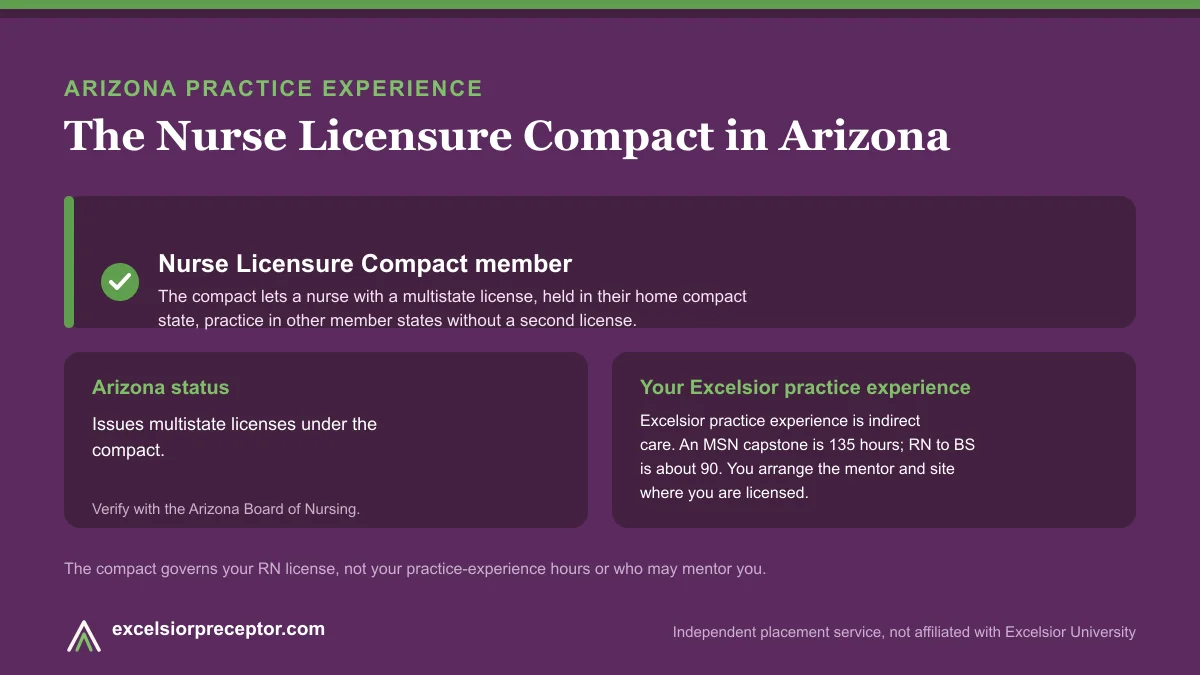
Arizona is a Nurse Licensure Compact state and implemented the compact on January 19, 2018. A multistate license from your primary state of residence generally lets you practice here, and the reverse holds for Arizona residents working in other member states. Eligibility turns on residency, so check your own case against the board and nursecompact.com. If your site will sit in another state, read out of state practice experience.
Host agencies care because even project work puts a named person in their buildings, their meetings, and often their data. Compliance will ask whether your license is active and clear, so have your license number and a current verification ready before the first real conversation.
Where Arizona's master's prepared mentors work
The graduate capstone needs a mentor with a master's degree or higher, expertise in your designated specialization, and willingness to volunteer, with capstone faculty approving the nomination. That is narrower than a nurse you happen to know, and it is the step that takes longest.
Start where those people are concentrated: Banner Health, HonorHealth, Dignity Health hospitals such as St. Joseph's in Phoenix and Chandler Regional, Mayo Clinic in Phoenix and Scottsdale, Valleywise Health, Phoenix Children's, Tucson Medical Center, Northern Arizona Healthcare in Flagstaff, and Yuma Regional Medical Center. If you already work at one, look inward first. Finding a mentor covers the search.
Where to look, by specialization
- Nursing education: hospital clinical education and professional development departments, and nursing faculty at Arizona State University's Edson College, the University of Arizona College of Nursing, Northern Arizona University, Grand Canyon University, Pima Community College, and the Maricopa Community Colleges. See nursing education mentors.
- Nursing informatics: clinical informatics and analytics teams inside the large systems, Contexture, which operates Arizona's statewide health information exchange, and state health data settings such as the Arizona Health Care Cost Containment System. See nursing informatics mentors.
- Leadership and administration: nurse managers, directors, quality and safety leaders, and chief nursing officers, plus public health nursing leadership at the Arizona Department of Health Services, Maricopa County Department of Public Health, and Pima County Health Department. See nursing leadership mentors.
- Rural and tribal Arizona: critical access hospitals, community health centers, Indian Health Service facilities in the Phoenix Area, and tribally operated systems such as Tuba City Regional Health Care. A small site may have only one qualified person, but that person is far easier to reach.
The site, the affiliation agreement, and CastleBranch
A mentor saying yes is half of it. The organization has to agree to host you, and usually an affiliation agreement between Excelsior and that organization must be in place before hours count. Large systems route agreements through legal or an academic partnerships office, on their calendar rather than yours. Two to six weeks is ordinary, so start that clock the day your mentor agrees. See the affiliation agreement.
Compliance runs in parallel. Excelsior uses CastleBranch, and host agencies often stack their own onboarding on top: background check, drug screen, immunizations and titers, tuberculosis screening, flu vaccination in season, privacy training, badge and system access. None of it is hard, all of it is slow if you start late, and some items expire. See CastleBranch compliance.
Third is the project: independent work the agency actually wants, matched to your specialization. An onboarding or curriculum redesign, a documentation or dashboard build, a throughput or safety improvement. Managers say yes faster when you arrive with a proposal instead of a request. See shaping the capstone project.
What 135 hours looks like on an Arizona calendar
Each graduate capstone carries 135 practice experience hours, with no extra hours awarded beyond that. The RN-to-BS practice experience is smaller, roughly 90 hours across two 45 hour courses. That is the entire obligation, not a weekly load. See how practice experience hours work and the RN-to-BS practice experience.
Across a standard term that is about eight to twelve hours a week, and most students working full time handle it in evening blocks, a weekend morning, and a standing check in with their mentor. Arizona adds a wrinkle: distance. A mentor in Tucson and a site in Casa Grande is a two hour round trip you will make more than once, so if you live in Flagstaff, Prescott, Sierra Vista, or Kingman, count the driving first.
Can any of it be remote?
A good deal of indirect care work can happen from a laptop. Informatics builds, curriculum writing, policy review, data analysis, and quality documentation do not require standing in the building, and plenty of Arizona sites are comfortable with a hybrid arrangement, especially through the summer.
Do not assume it counts. Whether remote hours are acceptable is decided by your capstone faculty and your host site together, and it depends on how the hours are supervised and documented. Ask both, in writing, before you build a plan around it. The safest pattern is hybrid: on site for meetings and your presentation, remote for the build.
If this has stalled, that is our job. We are an independent service, not part of Excelsior University, and we work the Arizona side: a master's prepared mentor in your specialization, an agency willing to host, and the paperwork kept moving. We cannot promise faculty approval or a timeline, but we can shorten the search. Get matched, or read how it works and what it costs first. Term starting soon? Start at need a mentor fast. Mentor withdrew? Mentor backed out.
Answered
Does my mentor have to be a nurse?
Excelsior's stated requirement is a person with a master's degree or higher who has expertise in the designated specialization and agrees to serve voluntarily, subject to capstone faculty approval. Most mentors are nurses, though an informatics or leadership project can reasonably point toward a related field. Ask your faculty before you spend weeks courting a nominee you are unsure about.
Can I use a multistate license from another compact state in Arizona?
Arizona is a Nurse Licensure Compact member and implemented the compact in January 2018, so a multistate license issued by your primary state of residence generally lets you practice here. Eligibility depends on residency and on the license you actually hold, so confirm your own case with the Arizona State Board of Nursing and with nursecompact.com.
Will I be doing direct patient care during my practice experience?
No. A graduate practice experience is indirect care and is not a clinical rotation. There is no patient assignment and no supervised shift. You carry out an independent project in an education, informatics, or leadership setting, with your mentor acting as a resource rather than a supervisor.
How long does it take to line this up in Arizona?
The mentor search takes longest, then the affiliation agreement, then compliance. Eight to twelve weeks before your term gives you room. Four weeks is tight, because large Phoenix and Tucson systems review agreements on their own schedule. At two weeks you depend on a site that already has an agreement on file. Nobody can promise a date, including us.
Let us line up the mentor, the site, and the project.
Tell us your program and your term. No payment until you are matched.
Get matched with a mentor