Your mentor, your site, and your project in Minnesota
Excelsior treats the practice experience as yours to arrange, which in Minnesota means finding a master's prepared mentor, an agency willing to sign an affiliation agreement, and a project your faculty will approve. Here is how those three pieces come together here.
Three pieces, and you own all three
Excelsior states that no clinical instruction is provided in any School of Nursing program. That is the design of a school built for working RNs, not an oversight. You bring the mentor, the site, and the project, and faculty approves what you bring rather than assigning any of it.
The graduate capstone runs 135 practice experience hours with an approved mentor. RN-to-BS students carry roughly 90 hours across two 45-hour courses, covered on the RN-to-BS practice experience page. Some students call the mentor a preceptor, since that is the word the rest of nursing uses, but a practice experience is not a clinical rotation and it is not direct patient care. It is education, informatics, or leadership work with a deliverable at the end.
In place before your capstone term opens
- A mentor with a master's degree or higher and real expertise in your specialization.
- A host organization willing to sign an affiliation agreement with Excelsior.
- A project the agency genuinely wants and faculty will approve. See capstone project.
- CastleBranch compliance cleared before your first hour.
The Minnesota Board of Nursing, and the license check to expect
RNs here are licensed by the Minnesota Board of Nursing, one of the state health licensing boards in Minneapolis. Its public verification tool shows anyone your license, its status, and its expiration date, and most host organizations will look before they let you count an hour on their property. Registrations run on a two year cycle keyed to your birth month and whether your birth year is odd or even, with 24 contact hours of continuing education per period and renewal handled online. Clear the renewal early so a lapsed registration never becomes the reason a project stalls.
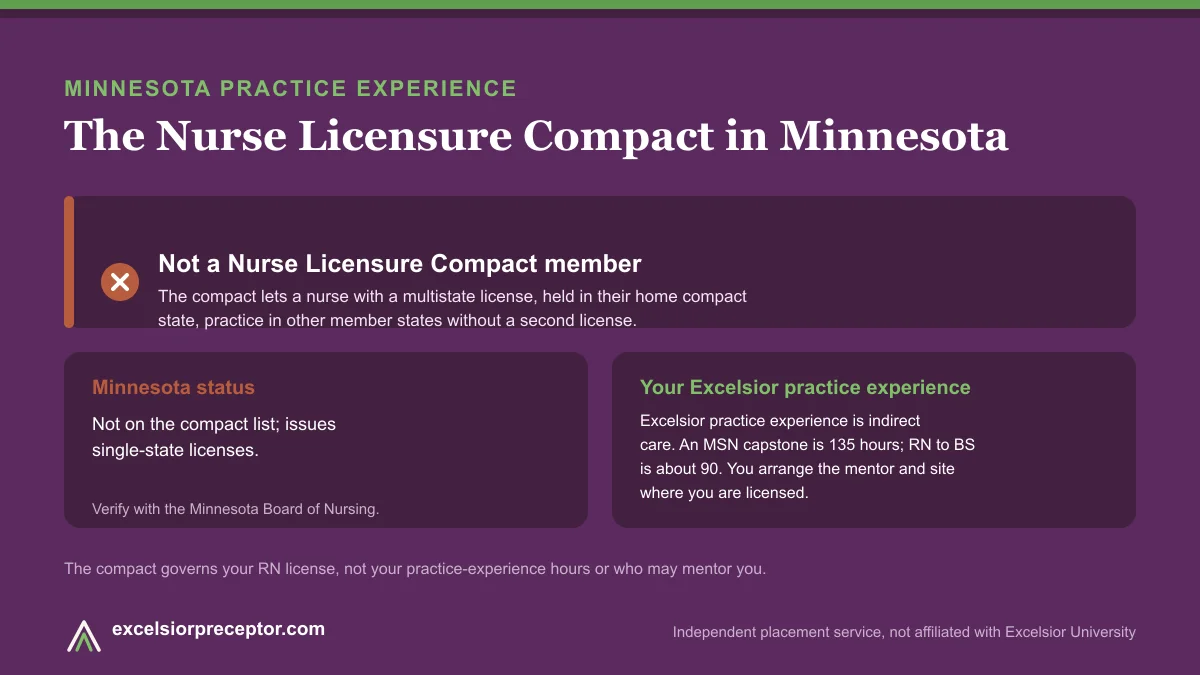
On the compact question, be careful. Minnesota does not appear on the Nurse Licensure Compact's list of implemented jurisdictions, while several of its neighbors do. A nurse who moved here from Wisconsin, Iowa, or the Dakotas on a multistate license should confirm requirements with the board rather than assume the old license carries over. Legislators have taken this up more than once, so check the current status at nursecompact.com.
Who can mentor you, and where those nurses work
You nominate the mentor and faculty approves or declines. The bar is a master's prepared professional whose daily work matches your specialization, and your capstone syllabus is the authority on the exact wording. Minnesota's advantage is supply. Few states pack this many integrated health systems, nursing schools, county public health departments, and health technology employers into one place.
Nominate someone whose actual job is the thing you want to study. An informatics student learns more from an analyst living inside the electronic health record build than from a friendly manager with a spare hour. Finding a mentor is a matching problem before it is a scheduling problem.
Where the right mentor already works here
- Education: nursing professional development teams at Mayo Clinic in Rochester, M Health Fairview and Hennepin Healthcare in Minneapolis, Essentia Health in Duluth, and CentraCare in St. Cloud, plus faculty at the University of Minnesota School of Nursing, St. Catherine University in St. Paul, Winona State University, and The College of St. Scholastica. See nursing education.
- Informatics: clinical informatics and electronic health record teams inside those systems, plus payer and device employers in the west metro such as Optum in Eden Prairie, Medtronic in Fridley, and Blue Cross and Blue Shield of Minnesota in Eagan. See nursing informatics.
- Leadership: managers, directors, and quality leaders at Allina Health and at independent organizations including North Memorial Health in Robbinsdale, Ridgeview in Waconia, and Winona Health. See nursing leadership.
- Public health: the Minnesota Department of Health in St. Paul, and county public health in Hennepin, Ramsey, Dakota, Olmsted, and St. Louis County.
Getting the site to say yes, and the paperwork signed
The mentor is the easy part once you find the right person. The agreement moves slower. Excelsior needs an affiliation agreement with the host organization before your hours begin, and at a large Minnesota system your mentor is not the one who signs it. It routes to a student placement office, then to legal or risk management, and the timeline runs in weeks.
Two local notes. The big Twin Cities and Rochester systems already hold agreements with dozens of schools, so ask early whether one with Excelsior exists rather than assuming it does not. And in greater Minnesota, a critical access hospital, a county public health department, or a long term care organization can often decide in a single meeting, because the person who says yes also signs. Smaller is frequently faster.
Alongside that, your compliance file runs through CastleBranch: background check, immunization records, and whatever the host adds on top. Minnesota sites commonly want their own orientation module and a badge first. Start it the month before your term. How it works lays out the order.
Distance, winter, and how much of this can be remote
Minnesota is a long state, and a student in Thief River Falls or Grand Marais is not driving to the metro twice a week in February. Indirect care work travels well. Curriculum builds, competency programs, workflow and dashboard projects, quality initiatives, and policy revisions can often be done partly by video and shared documents when the site and your faculty agree in advance.
That advance agreement is the whole point. Do not accumulate hours remotely and ask permission afterward. Put it in writing with your mentor and your course faculty before the term opens, and confirm what your program will count. We will build around a hybrid schedule, but Excelsior decides what counts, not us. See practice-experience hours, and out-of-state practice experience if your mentor sits across a border.
If your term starts soon and nothing is lined up
That is the state most Minnesota students reach us in, often eight to ten weeks out, sometimes after a mentor changed jobs or an agency reversed itself. We source the mentor, approach the site, and stay on the agreement until it is signed. You approve the match, faculty approves the mentor, and you pay once you are matched, not before. Pricing sits on the cost page.
Tell us your specialization, your county, and your term start date, and we will say honestly what is realistic. Get matched and we start this week. Replacing someone who fell through? Mentor backed out. Term nearly here? Need a mentor fast.
Answered
Is Minnesota a compact nursing state?
Minnesota does not appear on the Nurse Licensure Compact's list of implemented jurisdictions, so practicing here means holding a license issued by the Minnesota Board of Nursing rather than relying on a multistate license from elsewhere. Bills to join have surfaced repeatedly, so verify the current status at nursecompact.com and with the board before planning around it.
Does my mentor have to be in Minnesota?
Not automatically. Excelsior approves a mentor on credentials and expertise, not geography, and much of this work does not require standing beside anyone. The practical limits are your own license and the host site's rules. If your mentor or site is in Wisconsin, Iowa, or the Dakotas, read out-of-state practice experience and confirm with faculty first.
How many hours am I signing up for?
135 practice experience hours for the graduate capstone with a faculty-approved mentor, alongside the project itself. RN-to-BS students carry roughly 90 hours across two 45-hour courses. Your syllabus governs how hours are logged and verified, and practice-experience hours has the detail.
Can my own manager be my mentor?
Sometimes, if they hold a master's degree, have expertise in your specialization, and faculty approves the nomination. The complication is usually the project rather than the credential, since a direct supervisor's priorities can make honest evaluation awkward. Raise it with faculty early instead of finding out at submission.
Do you help Excelsior prelicensure or associate degree students?
No. Excelsior arranges clinical placement itself for its prelicensure Hybrid BSN program in St. Petersburg, Florida, and for its associate degree students. Our work is the graduate capstone practice experience and the RN-to-BS practice experience, where the school leaves the mentor, the site, and the project to you.
Let us line up the mentor, the site, and the project.
Tell us your program and your term. No payment until you are matched.
Get matched with a mentor