Finding an Idaho mentor for your Excelsior practice hours
Excelsior University states that no clinical instruction is provided in its School of Nursing programs, so for the MSN capstones and the RN to BS practice experience the mentor, the site, and the project all start with you. Here is how a registered nurse in Idaho assembles those three pieces.
Your Idaho RN license is the first thing anyone checks
Registered nurses here are licensed by the Idaho Board of Nursing, which sits inside the Idaho Division of Occupational and Professional Licenses, the agency everyone calls DOPL. Applications, renewals, and status changes run through the Board's online nurse portal, and license status is publicly verifiable through the Board's search.
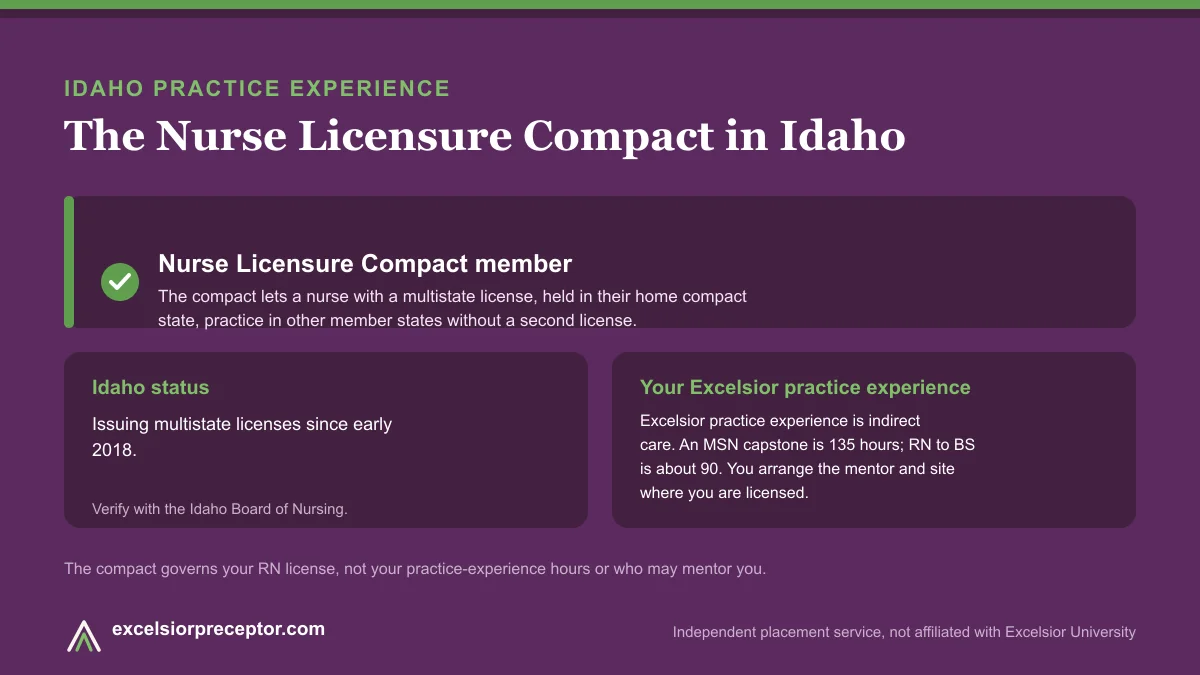
Idaho is a Nurse Licensure Compact state and implemented the current version in January 2018. If Idaho is your primary state of residence you can hold a multistate license issued here. If you live in another compact state and your host agency is in Boise or Coeur d'Alene, your existing license may already cover you. If the agency sits across a border, confirm that state's compact status first.
Settle this before you approach anyone. A hospital, a nursing school, or a health district will run your license before it lets you sit in on committee work, open a data set, or teach. Check your expiration date on the Board's site rather than trusting memory, since Idaho has been adjusting its nurse renewal schedule.
Who counts as a mentor, and where to find one here
Excelsior says mentor, not preceptor, though plenty of students search the second word. Your mentor is a volunteer, master's prepared professional whose expertise matches your specialization. You nominate the person; faculty approve the nomination and do not assign one, so you are recruiting rather than waiting. Your own employer is usually the fastest lead.
Match the mentor to your track
- Nursing education: faculty and clinical education staff at Boise State University, Idaho State University, Lewis-Clark State College in Lewiston, Northwest Nazarene University in Nampa, and Brigham Young University-Idaho in Rexburg, plus the associate degree programs at the College of Western Idaho, the College of Southern Idaho, and North Idaho College.
- Nursing informatics: clinical informatics and applications teams at St. Luke's Health System, Saint Alphonsus Health System, Kootenai Health in Coeur d'Alene, and Portneuf Medical Center in Pocatello, plus the Idaho Health Data Exchange in Boise, which runs the statewide health information exchange.
- Leadership and administration: nurse managers, quality directors, and directors of nursing in those systems, and the seven Idaho public health districts, from Panhandle Health District in the north to Southeastern Idaho Public Health in Pocatello.
The site, the agreement, and the paperwork
A willing mentor is only half of it. You also need a host agency, and usually an affiliation agreement between that agency and Excelsior. It covers liability and student status, and it gets signed by a contracts office you may never speak to. Ask early who handles those agreements at your site and pass the name to your faculty.
Timelines swing widely here. A critical access hospital in Salmon or a clinic in Sandpoint may sign in a week because one administrator decides. A large Treasure Valley system with a legal department can take a month, especially if it insists on its own template. If an agency asks about your program, Excelsior's bachelor's and master's nursing programs are accredited by ACEN, and the university is institutionally accredited by MSCHE.
Compliance runs through CastleBranch: background check, immunization records, tuberculosis screening, sometimes a drug screen, and whatever onboarding the host adds. Idaho systems routinely require their own badge, privacy, and records training even when your project never touches a patient. Start that file early, because titers and old records take longer to retrieve than anyone plans for.
What 135 hours actually looks like
Each MSN capstone carries 135 practice experience hours attached to an independent project. RN to BS students carry a lighter load, about 90 hours split across two 45 hour courses. Those are course totals, not weekly figures, and how you spread them is worked out with your mentor and the site.
This is indirect care. A practice experience is not a clinical rotation and not direct patient care; you are building curriculum, mapping a workflow in the electronic record, running a quality improvement cycle, or working on staffing and policy. Idaho students often anchor the project locally: nurse retention at a small rural hospital, onboarding for travel staff in the Magic Valley, discharge documentation at a district clinic, or immunization reporting in a rural county.
The project is the point of the hours. If you can describe the problem you want to work on before you ask anyone to mentor you, the conversation changes, because you are requesting oversight on defined work rather than asking a busy person to invent an assignment. See capstone project.
Distance, time zones, and remote work
Idaho is a long state. Boise to Coeur d'Alene is most of a day of driving, and the northern panhandle runs on Pacific time while the rest of the state runs on Mountain time. If your mentor is in Hayden and you are in Pocatello, build that hour into every standing meeting.
Because the work is indirect, much of it can often be done remotely or in a hybrid pattern. Curriculum drafting, informatics analysis, policy review, and data work do not always require you in the building. Approval is case by case between your faculty and the host site, and nobody, including us, can promise your hours count that way, so ask your program in writing first. If no local match exists near Bonners Ferry or Rexburg, see out of state practice experience.
When the search stalls
Most Idaho students who get stuck are not stuck on forms. They are stuck because the one nurse educator they knew retired, or the informatics manager who said yes in March moved systems in June. That tends to surface late, with no term left to absorb it.
That is the gap we fill. We are an independent placement service, separate from Excelsior University or ACEN, and we do not guarantee placement or Excelsior's approval of any mentor or site. We source and vet candidate mentors in Idaho who match your specialization and keep the agreement moving. Get matched and tell us your track, your county, and your deadline; pricing is on the cost page.
Answered
Does Excelsior find my mentor for me?
No. Excelsior states that no clinical instruction is provided in its School of Nursing programs, and for graduate practice experience courses you nominate the mentor and secure the site yourself. Faculty review and approve your nominee rather than assigning one.
Does my compact license work in Idaho?
Idaho is a Nurse Licensure Compact state, so a multistate license issued by your primary state of residence generally lets you practice here. If Idaho is your primary residence, apply for the Idaho multistate license through the Board of Nursing. Either way, the host agency will verify it.
Can my own manager be my mentor?
Often yes, if that person is master's prepared, their expertise matches your specialization, and your employer will host the project. Faculty still approve the nomination. Staying inside your own organization also shortens the agreement step. See find a mentor.
Is this the same as a preceptorship?
Some students call it a preceptor arrangement, because that is the word most nursing programs use, but Excelsior says mentor and the work differs. At the graduate level you are doing indirect care: education, informatics, or leadership projects under a qualified person's oversight. See mentor vs preceptor.
Let us line up the mentor, the site, and the project.
Tell us your program and your term. No payment until you are matched.
Get matched with a mentor