Finding a mentor, a site, and a project in Connecticut
Excelsior University does not assign you a mentor or a practice experience site. You bring both to your faculty, along with a project, and faculty approves what you brought. Here is how that gets done in Connecticut.
Three pieces, and the order that saves you a term
Every Excelsior practice experience rests on things you supply: a mentor who meets the standard, a host willing to sign an affiliation agreement with the university, and a project the site genuinely wants finished. This is indirect care graduate work, education, informatics, or leadership, so your host is usually a department rather than a nursing unit.
The mentor opens the door to the site, not the other way around. If you already work inside Hartford HealthCare, Yale New Haven Health, Trinity Health Of New England, UConn Health in Farmington, or Connecticut Children's, your mentor is often two floors away in staff development, quality, or informatics. If you are not inside a large system, target places that run programs rather than beds: a local health district, a community health center, a school district health office, or a nursing program that needs curriculum work.
What you own, and what faculty owns
- You nominate the mentor. Faculty approves or declines.
- You get the site to the affiliation agreement stage.
- You scope a project with an outcome the site cares about, clear compliance, and keep your hours log.
Your RN license is the first thing a Connecticut host checks
Registered nurses here are licensed by the Board of Examiners for Nursing, inside the Connecticut Department of Public Health in Hartford. You are already licensed, so the board matters to you as the body that keeps your credential current and publicly verifiable. Nothing in this work asks you to practice beyond your RN license.
Lookup, verification, and renewal run through eLicense.ct.gov. The state treats that lookup as primary source verification and updates it instantly, which is why a hospital education department, a health district director, or a university human resources office checks you before anyone signs. Read your own record before you send an introduction email, because a lapsed status stalls an agreement faster than any paperwork problem.
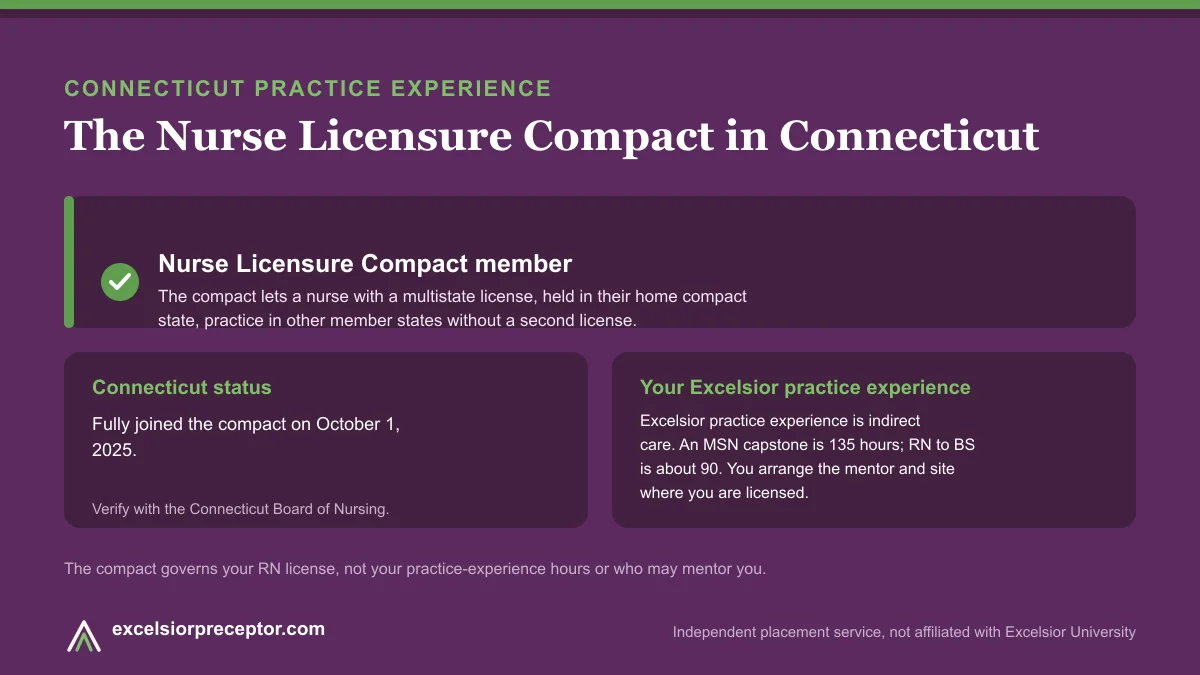
Connecticut implemented its participation in the Nurse Licensure Compact effective October 1, 2025. Nurses whose primary state of residence is Connecticut can convert a single state license to a multistate license through eLicense, under Nurse Compact in the More Online Services menu. The Department of Public Health says there is no fee to convert and that applicants submit fingerprints for background checks. If you commute in from a neighboring state, confirm your own home state status on nursecompact.com.
Who qualifies as your mentor, and where those people work
Excelsior asks for a volunteer mentor who is master's prepared with expertise in your specialization, with faculty approving your nominee. Some students call this person a preceptor, because that is what everyone types into a search bar, but Excelsior's word is mentor: terminology explained.
For nursing education, the pool is professional development specialists and clinical educators at Hartford Hospital, Yale New Haven Hospital, Bridgeport Hospital, Saint Francis in Hartford, Saint Mary's in Waterbury, Danbury Hospital, Stamford Health, and Lawrence and Memorial in New London, plus nursing faculty at Southern and Central Connecticut State, Western Connecticut State in Danbury, University of Saint Joseph in West Hartford, Fairfield, Sacred Heart, Quinnipiac in Hamden, Goodwin in East Hartford, and CT State Community College campuses such as Gateway and Housatonic. See education mentors.
For informatics, look at clinical informatics and electronic record teams inside the larger systems, quality and analytics groups, and Connie, the statewide health information exchange run by the Health Information Alliance. Connecticut also holds an unusual density of payer employers around Hartford and Bloomfield, including Aetna and Cigna, where master's prepared nurses work in care management analytics. See informatics mentors.
For leadership, nurse managers, directors, quality leaders, and public health administrators qualify when their expertise matches. Connecticut runs local public health through 59 local health agencies, including districts such as Ledge Light around New London and Groton and Naugatuck Valley serving Ansonia, Derby, Seymour, and Shelton, plus city health departments in Hartford, New Haven, Bridgeport, and Stamford. See leadership mentors, or let us search at find a mentor.
The site, the agreement, and your CastleBranch file
A verbal yes from a mentor is not a site. Before you log an hour, the host signs an affiliation agreement with Excelsior, and that document usually travels through a different office than the one that wants your project. In Yale New Haven Health, Hartford HealthCare, or Trinity Health Of New England, that means a central placement or legal office on institutional timelines. Plan in weeks, not days. If a site asks who accredits your program, the answer is ACEN.
Smaller sites cut the other way. A health district in Torrington, a community health center in Middletown, or a skilled nursing facility in Bristol may never have seen a university agreement. There is no queue, but there is also no process, so you hand-carry the document and follow up often. Mechanics for both are in how it works.
Compliance runs through CastleBranch: immunizations, background screening, and whatever the site adds, often its own onboarding module and badge process. Open that file before the site says yes, because records requests quietly eat weeks. Some hosts want proof of liability coverage.
What 135 hours looks like on a real calendar
Each MSN capstone carries 135 practice experience hours paired with an independent project. The RN-to-BS practice requirement is roughly 90 hours across two 45 hour courses. Quote those honest numbers when a site asks how much of their people's time you need. Detail sits on practice experience hours and RN-to-BS practice experience.
Across an eight week term, 135 hours is about 17 hours a week. Over fifteen weeks it is closer to nine. A graduate practice experience is not a clinical rotation and it is not direct patient care, which is the thing to explain to a manager who assumes you want to shadow on a unit.
Log hours the day you work them, with the objective each one served. Mentor meetings, stakeholder interviews, data pulls, building and piloting the education module, and writing the evaluation typically count, but your faculty defines what qualifies. Scoping guidance is at capstone project.
Remote work, commuting students, and getting help
Indirect care projects travel well. Curriculum builds, dashboards, policy revision, and quality analysis can often be done partly off site, and many Connecticut students split their time, on site for meetings and observation, remote for building and writing. That only exists when the host agrees and your faculty approves in advance. Never bank remote hours assuming they will be accepted later.
Plenty of students in Fairfield County live in one state and work in another. If your site and your residence do not match, read out of state practice experience first.
If your search has stalled, that is why we exist. We are an independent service, not part of Excelsior University. We source Connecticut mentors, move sites to the agreement stage, and help shape a project faculty will approve. Fees are at cost, tight timelines at need a mentor fast, and you can get matched any time.
Answered
Does Excelsior find my mentor or site in Connecticut?
Not for the graduate programs or the RN-to-BS practice courses. You identify the mentor, secure the host, and propose the project, and faculty approves. Excelsior does arrange placement for its prelicensure Hybrid BSN and associate degree programs, so a classmate in one of those tracks has a different experience than you do.
Does my mentor need a Connecticut nursing license?
The academic standard is a master's prepared professional whose expertise matches your specialization, approved by faculty. Licensure belongs to the host site. If your mentor practices as a nurse in Connecticut, the employer expects a license valid here, which since October 1, 2025 can be a Connecticut license or a multistate license from another compact state.
Can part of my 135 hours be remote?
Sometimes, and it depends on two approvals. The host has to agree to remote work on their project, and your faculty has to accept it for your course. Informatics and curriculum work suit it better than leadership rounding. Get both answers before you start.
How early should I start looking in Connecticut?
A full term before your practice experience course opens. In large systems the affiliation agreement passes through a central office with its own queue, smaller hosts move faster on paper but need more explaining, and CastleBranch runs in parallel.
What if my mentor backs out mid term?
It happens, usually from a job change, and it is recoverable if you move fast. Tell faculty immediately, ask the site whether a colleague with matching expertise can step in, and start a parallel search rather than waiting on a maybe.
Let us line up the mentor, the site, and the project.
Tell us your program and your term. No payment until you are matched.
Get matched with a mentor